


- Home
- Practice Areas
- Aggravated Assault
New Jersey Aggravated Assault Lawyer
Aggravated assault is a Felony offense in New Jersey. Joel Silberman has defended Aggravated Assault charges across the State of New Jersey.
Call 201-420-1913Free Consultation
A Felony Charge With State Prison Exposure
Aggravated assault is a Felony offense in New Jersey. Third Degree Aggravated Assault is punishable by between 3-5 in State Prison while Second Degree Aggravated Assault is punishable by 5-10 years in State Prison subject to the No Early Release Act (“NERA”.) NERA requires that an individual serve 85% of whatever sentence they receive before they are eligible for parole. In addition, NERA requires mandatory parole supervision upon release.
Joel Silberman has defended Aggravated Assault charges across the State of New Jersey. If you have been charged with Aggravated Assault in Hudson, Essex, Bergen, Passaic, Middlesex or Monmouth County please call for a free consultation.
Charged or under investigation? Call 201-420-1913 before your first court date for a free, confidential consultation.
What Makes an Assault “Aggravated”
Under New Jersey law assault is graded by the seriousness of the injury as well the use of a weapon. The seriousness of the injury determines the grade of the offense and the potential sentencing exposure. Third Degree Aggravated Assault carries potential prison sentences of 3-5 years while Second Degree Aggravated Assault can expose an individual to 5-10 years in prison subject to NERA.
The Law Offices of Joel Silberman, LLC is a New Jersey criminal defense firm. Joel Silberman has defended hundreds of Aggravated Assault cases and is a former Assistant Prosecutor who prosecuted aggravated assault cases. Joel Silberman has extensive experience in how Aggravated Assault cases are investigated, charged, screened, negotiated, and tried. Joel Silberman has successfully had countless Aggravated Assault cases dismissed for various reasons.

Three Steps That Protect Your Defense

The following steps are critical immediately after you have been accused of or charged with Aggravated Assault:
How Aggravated Assault Is Graded in New Jersey

The same incident can be charged several ways. The exact subsection on the complaint sets the degree, the sentencing range and whether special sentencing laws apply. Very often the degree turns on the injury. Bodily injury is physical pain, illness or any impairment of physical condition. Significant bodily injury is a temporary loss of the function of a body part or organ, or of one of the five senses. Serious bodily injury creates a substantial risk of death, or causes serious permanent disfigurement or a protracted loss or impairment of a body part or organ. A deadly weapon is anything used, or meant to be used, in a way capable of causing death or serious bodily injury: a bottle, a bat or a car can qualify, and so can an everyday object, depending on how it was used.
A broken nose, stitches or a concussion is not automatically “serious bodily injury”. Medical records and, where appropriate, an independent medical opinion can show whether the injury meets the legal standard. Because the statute also covers attempts, the State may argue that a worse injury was intended, so the evidence of intent matters as much as the medical records.
Aggravated Assault
Second degree: 5 to 10 years in state prison and a fine of up to $150,000. The No Early Release Act requires 85% of the term before parole, then 3 years of parole supervision: about five years and one month on a six-year sentence, and eight and a half years on the ten-year maximum.
Third degree: 3 to 5 years and a fine of up to $15,000. First offenders generally have a presumption against prison (not for significant injury to a domestic violence victim).
Fourth degree: up to 18 months and a fine of up to $10,000; a presumption against prison for most first offenders.
If a gun was used or possessed: on conviction, the Graves Act requires a parole bar of half the sentence or 42 months, whichever is greater (18 months for fourth degree). A first offender may get a waiver, but only on the prosecutor’s motion, so how the defense presents the case to the prosecutor matters.
A sentence can also include probation, restitution for the alleged victim’s medical bills and losses, anger-management or substance-abuse counselling, a no-contact order and mandatory court assessments.
Simple Assault
Simple assault, under N.J.S.A. 2C:12-1a, carries up to six months in county jail and a fine of up to $1,000. A fight entered into by mutual consent is only a petty disorderly persons offense.
Getting an aggravated assault charge downgraded to simple assault keeps it out of Superior Court and off an indictable record. Learn more about simple assault.
From Arrest to Resolution: How the Case Moves
Aggravated assault cases are prosecuted by the County Prosecutor’s Office and heard at the Superior Court. By way of example, in Hudson County the Superior Court is the Frank J. Guarini Justice Complex, 24 Central Avenue, Jersey City. Essex County cases go to the Veterans Courthouse, 50 West Market Street, Newark.
Complaint
First appearance at CJP
Release or detention
Pre-indictment
Grand jury and motions
Plea cut-off or trial

Defenses in Aggravated Assault Cases
The right defense depends on the evidence. These are the questions Joel Silberman looks at when reviewing an aggravated assault case:
Self-Defense
The Injury
Weapon and Intent
Identification
Searches and Statements
Credibility
Keeping an Aggravated Assault Off Your Record
An arrest does not have to end in an indictable conviction. Depending on the facts and your record, the realistic goals include:
Downgrade and remand to municipal court
The prosecutor can reduce the charge to simple assault and send it to municipal court, avoiding an indictable conviction and state prison. A simple assault conviction still carries consequences, so the terms matter.
Pretrial Intervention (PTI)
PTI moves the case into supervision, and the charge is dismissed when the program is completed. It can be available for third- and fourth-degree charges. Second-degree and Graves Act cases need the prosecutor’s consent, and an assault on a law enforcement officer causing serious bodily injury is barred.
Dismissal, a lower degree, or acquittal
Other results include a dismissal, a grand jury’s refusal to indict, a plea to a lower degree that avoids NERA or prison, or a not-guilty verdict at trial. In a second-degree case, avoiding the No Early Release Act is often the single most important goal.

Aggravated Assault on an Officer
A client was charged with aggravated assault on an officer. At our first appearance, the matter was remanded to the Jersey City Municipal Court, where the charge was further reduced to a town ordinance violation.
Results may vary depending on your particular facts and legal circumstances.
Types of Aggravated Assault Charges
The statute lists thirteen ways to commit aggravated assault. These are the main ones, with the degree each carries:
Serious Bodily Injury
Strangulation (Domestic Violence)
Injury While Fleeing Police
Fire or Explosion Injuring Responders
Assault With a Deadly Weapon
Significant Bodily Injury
Significant Injury to a Domestic Violence Victim
Pointing a Gun, Imitation Gun or Laser Sight at an Officer
Assault on a Police Officer
Assault on a Protected Worker
Reckless Injury With a Deadly Weapon
Pointing a Gun at a Person, Loaded or Not
Domestic violence cases. When the alleged victim is a spouse, partner, former partner, family or household member, or someone you have dated, two of the charges above are specific to that relationship. Strangulation, by pressure on the throat or neck or by blocking the nose or mouth, has been a second-degree crime since 2021. Aggravated assault is also a predicate act under the Prevention of Domestic Violence Act, so a restraining order case usually runs alongside the criminal case in the Family Part, and what you say in one can be used in the other. Joel Silberman defends both: see Domestic Violence and Restraining Orders.
If a gun was involved, see Gun and Weapons Offenses.
Assault on a Police Officer or Protected Worker
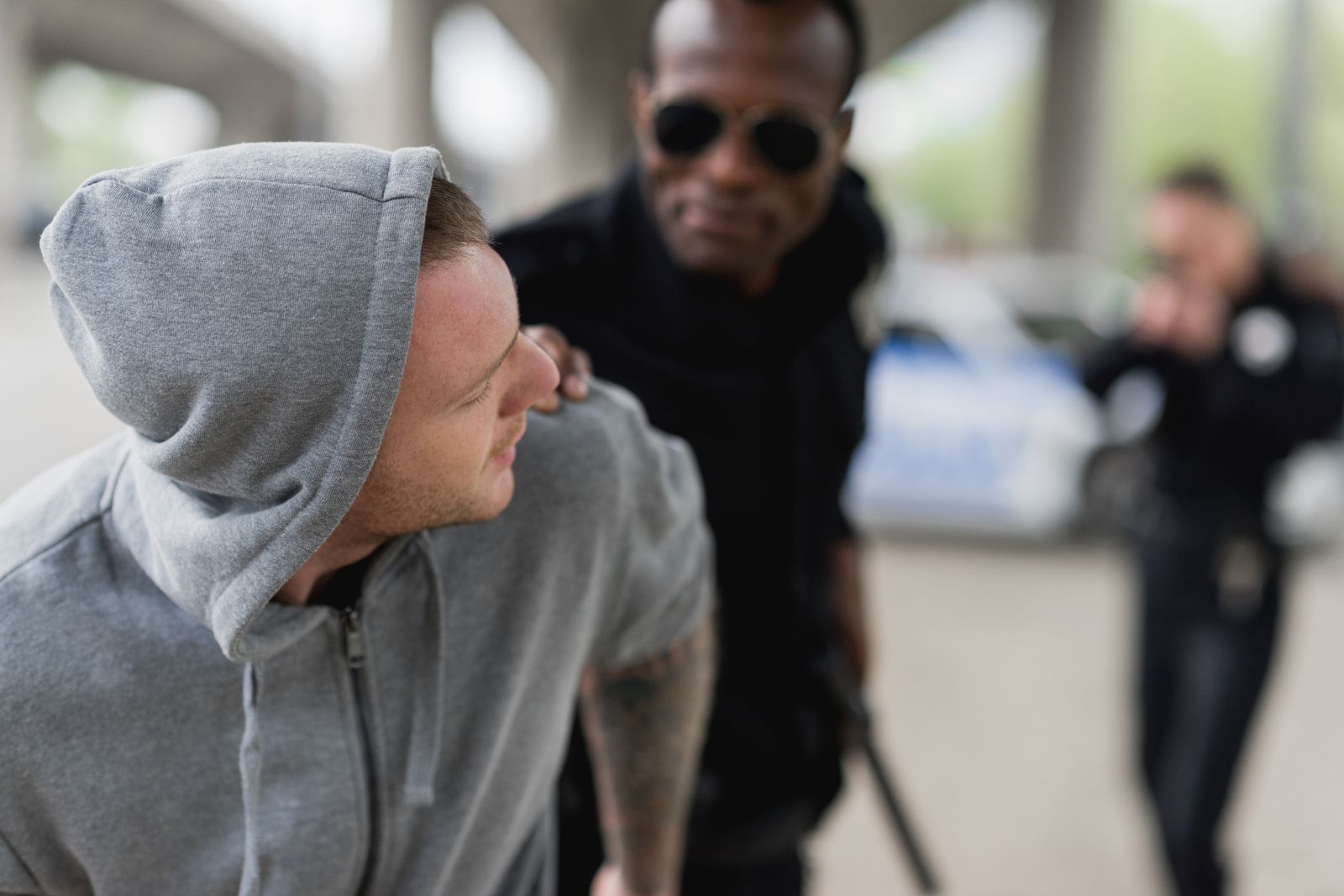
Under N.J.S.A. 2C:12-1b(5), a simple assault becomes aggravated assault when it is committed against certain workers on the job: police and other law enforcement officers; paid and volunteer firefighters, EMTs and first-aid personnel; teachers, school administrators, school board members, school bus drivers and other school employees; DCPP employees; judges; bus operators, their supervisors and rail employees; corrections, sheriff’s and probation officers and juvenile detention staff; utility and cable workers on a service call; health care workers giving direct patient care; direct care workers at State or county psychiatric hospitals, State developmental centers and veterans’ memorial homes; and, since April 2025, retail store employees.
These cases often come out of a fast-moving arrest and are often filed with resisting arrest. Body-worn camera footage and the officers’ reports do not always match. The State must also prove the worker’s status: for most, that they were clearly identifiable as doing their job; for police and some others, it can be enough that they were targeted because of the job.
Police Officers
Other Protected Workers
Retail Employees

What an Aggravated Assault Conviction Can Cost You
An aggravated assault conviction leaves an indictable criminal record that can follow you for years, long after any sentence ends. For anyone who is not a U.S. citizen, the immigration impact can be more serious than the sentence, so it should be reviewed before any plea is accepted.
Aggravated Assault Defense in Jersey City, Hudson County and Newark

Joel Silberman spent nearly four years as an Assistant Prosecutor in the Hudson County Prosecutor’s Office, in its Trial, Juvenile and Appellate Units, prosecuting cases that included aggravated assault, homicide and gun offenses, with specialized instruction in identifications and motions to suppress, two of the most common battlegrounds in an assault case. Before that, he clerked for the Honorable George F. Rohde, Jr., J.S.C., in the Criminal Part of the Superior Court in Passaic County. He works with medical experts and private investigators to test the State’s injury claims and to find video and witnesses before they disappear. Read more about Joel.
Our offices are at 26 Journal Square, Suite 300, Jersey City, NJ 07306 and 744 Broad Street, 16th Floor, Newark, NJ 07102. We defend aggravated assault charges in Hudson County (Jersey City, Hoboken, Bayonne, Union City, North Bergen, West New York, Weehawken, Secaucus, Kearny, Harrison, Guttenberg and East Newark), in Newark and the rest of Essex County (East Orange, Irvington, Orange, West Orange, Bloomfield, Belleville and Montclair), and in Superior Courts throughout New Jersey.
Call 201-420-1913, day or night.
What Clients Say
Disclaimer: “Results may vary depending on your particular facts and legal circumstances.”
Contact a New Jersey Aggravated Assault Lawyer
An aggravated assault charge is serious, but it is still an accusation, and the State has to prove every element beyond a reasonable doubt. Call 201-420-1913 for a free, confidential consultation; Joel is available 24/7. You can also read common questions about assault charges.
Call 201-420-1913Free Consultation